Project 01
The Day Boston Was Hit by a Wave of Molasses
A historical disaster explored through research, narrative tension, human impact, and visual storytelling.
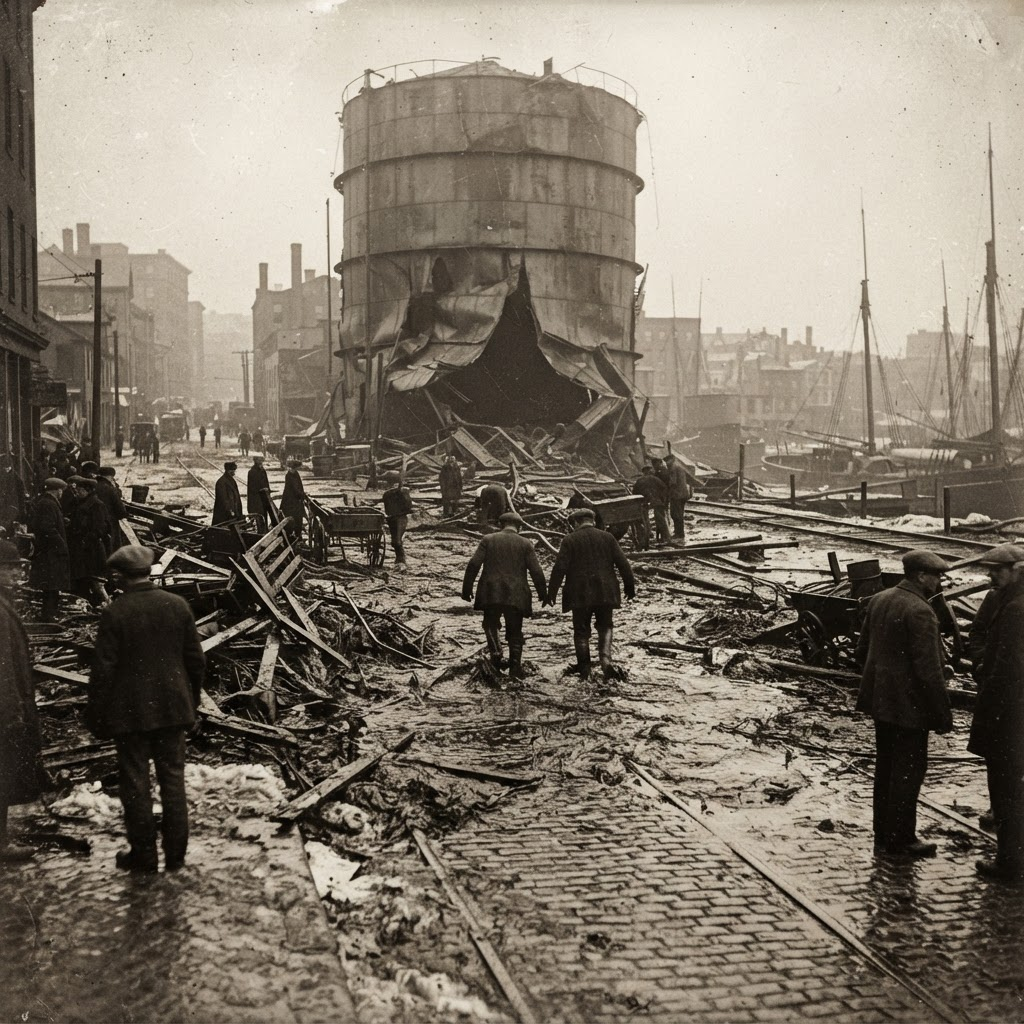
Hook
On a warm January afternoon in 1919, the residents of Boston’s North End heard a sound like a machine gun. Then the ground began to tremble. What came next was not a storm, not an earthquake, and not a fire — it was a fifteen-foot wave of molasses moving faster than a person could run.
Introduction
It sounds like the setup to a joke. A flood of syrup. Something sticky and slow and almost cartoonish. But the Great Boston Molasses Flood was one of the strangest and deadliest industrial disasters in American history — and the story of how it happened says as much about the era as it does about the accident itself.
To understand how a storage tank could kill twenty-one people and injure a hundred and fifty more, we have to go back to the years before the flood, to a company under pressure, a city in transition, and a piece of infrastructure that almost everyone had quietly agreed to ignore.
Main Story
SECTION 01 — The Tank on Commercial Street
The tank was built in 1915 by the Purity Distilling Company. It stood fifty feet tall and ninety feet across, and it loomed over the crowded, working-class waterfront of the North End. Molasses, at the time, was not just a sweetener. It was raw material — fermented into industrial alcohol, and, during the First World War, into munitions.
From the beginning, the tank leaked. Locals noticed the drips and even collected molasses for their homes. The company’s response was not to repair it, but to paint the tank brown so the leaks would be harder to see.
SECTION 02 — A Question of Pressure
In the days before the disaster, a fresh delivery of warm molasses was pumped into the tank, which had been holding colder product. The temperature difference mattered. So did the fact that the tank had never been properly tested — filled with water to check for weaknesses — before being trusted with millions of gallons of liquid.
This is the part of the story that turns a freak accident into something more troubling. The failure was not random. It was the predictable result of decisions made, and not made, over several years.
SECTION 03 — The Wave
When the tank gave way, it released an estimated 2.3 million gallons of molasses. The wave crushed buildings, buckled the elevated railway, and swept people, horses, and debris into a suffocating tide. Witnesses described the horror of trying to move through something that pulled harder the more you fought it.
Rescue was slow and grim. The molasses hardened in the cold, trapping victims and turning the cleanup into a weeks-long ordeal that residents said left the harbor brown until summer.
SECTION 04 — What the Flood Left Behind
The lawsuit that followed was one of the first large class actions in Massachusetts. For the first time, a company was held publicly accountable for cutting corners on safety, and the case helped push the country toward stricter engineering standards and building codes.
That is the quiet legacy of a story that sounds absurd. The rules that protect the buildings we sit in today were written, in part, because of a disaster people still struggle to take seriously.
Ending
The Boston Molasses Flood endures because it lives in two registers at once: the almost comic image of a syrup wave, and the very real cost paid by the families who lived beneath that tank. Holding both is the point.
It is a reminder that history is rarely tidy, and that the strangest stories often carry the most human lessons — about pressure, about accountability, and about the danger of looking away from a problem simply because it is inconvenient to see.